831-431-6726


Wastewater System Services
We provide several services depending on your needs.
Here are the common ones:
-Service Provider for regular maintenance that is usually included in our annual/bi-annual inspections. (Different Systems have different needs and requirements see the section below regarding helpful definitions and our Residential Systems page for more info on the kind of system you have.)
-Service Agreement requests for an established/built system.
-Service Agreement requests for a system soon to be built.
-Emergency response to your system being in ALARM, or it smells, you have dirty water
coming out of your drains, or your dispersal field is sodden. Please see our FAQs for info on what you can do in the meantime.
-Solids Pumping: Ask about our cost savings service on treatment tank
and disposal tank solids management.
-Engineering Project or Consultation for Installation or design of a system.
-Consultation, usually for purchase inspections, when you are considering
buying property that has a septic system of some sort already installed. See more below.

Buying or Selling Your Home?
As an On-site System Service Provider (OSSP), Essential Operations offers comprehensive inspections and reports for traditional, enhanced, and lift station septic systems, adhering to the standards set by the National Association of Wastewater Technicians. Our thorough assessments ensure you understand the current condition of your system.
A Sales Inspection service can vary in what is needed to provide the buyer with a thorough report but at a minimum it will include:
Research
Background on the system through the County/other agencies
Photo Documented Inspection
Including a 45 minute disposal system water flow test
Thorough Report
System's current condition and any recommendations for future maintenance or repair
Possible Additional Services if Applicable/Accessible
Lift Station test, Disposal field investigation
This service is provided at our consulting rate and includes travel time to and from the property.
Some Helpful Definitions
Septic System (Conventional)
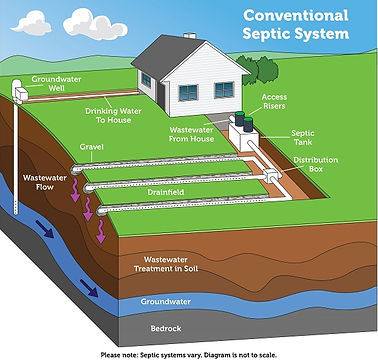
Typically installed at a Single-family home or small business it consists of a septic tank and a drain field, sometimes also called a leach field or disposal field, a trench or bed subsurface wastewater infiltration system. The effluent (liquid waste) is piped from the septic tank to the shallow underground trench of stone or gravel. The waste filters through the stone/gravel and is further treated by microbes in the soil. The footprint of this system is relatively large and may not be suitable for all residential properties or conditions. Here is an interactive resource to learn more about how Septic systems work.
If being used appropriately (no hard to process or large amounts of waste) these systems usually only need an annual inspection and pumping of the solids that build up every 3-5 years.
Alternative System
Sometimes called Enhanced or Innovative Systems these septic systems can use/be a variety of technologies and designs that treat wastewater more effectively than traditional/conventional methods/systems. They are often used for locations that have space constraints, limiting soil types, or specific local regulations. The primary goal being that by the time the liquid waste reaches the soil it is cleaner, putting less strain on the local soil/space/ground water.
These systems can often require more frequent maintenance and inspections due to their more complex nature and local regulation/reporting requirements (See OSSP below).
OSSP
It stands for: On-site system service provider (OSSP) for residential enhanced or alternative wastewater treatment system inspections. When you receive a notification from the County that you need an OSSP report completed we can provide that service. Depending on your system, the frequency of those reports can vary as well as your system type and county requirements. We'd be happy to help you determine your regulation requirements and set up a regularly scheduled service inspection.
Residential vs Commercial Treatment Systems
It comes down to the amount processed and the types of waste being processed. Residential systems tend to process relatively consistent and smaller amounts of organic/human waste, household cleaning chemicals, and water amounts. This varies only slightly depending on household size, season, and lifestyles of those living there. Commercial systems often process large amounts of waste and can contain more toxic or complex waste such as pharmaceuticals from medical centers or heavy metals from industrial facilities. These systems often require a much more specialized treatment to meet environmental safety regulations.
For more definitions and answers to our most commonly asked questions, please visit our FAQ page.